Upcoming Event: Oden Institute Seminar
Data assimilation in high dimensions: weather prediction and latent spaces
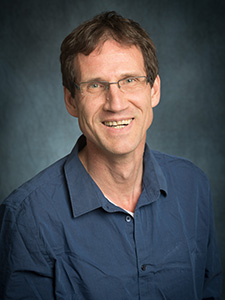
Peter Jan van Leeuwen, Professor in Data Assimilation and Physical Oceanography, Colorado State University
3:30 – 5PM
Thursday Oct 1, 2026
POB 6.304 and Zoom
Abstract
Data assimilation is sequential Bayesian Inference, typically involving complex numerical models that evolve model states over time and complex indirect observations of the model states over time. It is the backbone of many societal relevant prediction problems, such as weather prediction, oil reservoir management, risk management, space weather prediction, etc. The prediction problems are often time critical, highly nonlinear and high dimensional.
Focusing on weather prediction, typical state dimensions are 10^11, with observation vector dimensions 10^8, with a 6 hour cycle with 5 hours of observation collection and preparation, and 1 hour to perform the Bayesian inference. I will explain how the operational weather prediction centers solve this problem, including the near-Gaussian assumptions. Then recent developments using machine learning will be highlighted, including how YOU can get directly involved via the Anemoi project, bypassing all industry efforts. Furthermore, I will discuss recent developments in fully nonlinear data assimilation using what we now call traditional methods and machine-learning methods, including efforts on data assimilation in the machine-learned latent space.
Biography
Dr Van Leeuwen obtained BSs in Physics, Astrophysics, and Physical Chemistry, an MS in theoretical physics, and a PhD in Coastal Fluid Dynamics in the Netherlands. He was Professor in Data Assimilation at the University of Reading, United Kingdom, leading the 35-scientists strong Data Assimilation Research Centre (DARC), heading the Data Assimilation Theme in the National Centre for Earth Observation (NCEO), and was Interim Director of NCEO. NCEO is a consortium of 13 research institutes and universities in the UK. He won an Advanced Investigator Grant from the European Research Council, the highest personal research award in the European Union. He recently moved to Colorado State University, where he leads a group of 4 PhD students and 3 postdocs. The group works on nonlinear data assimilation, machine learning, and nonlinear causal discovery and the flow of information in complex systems, interocean exchanges in the southern ocean, submesoscale air-sea interactions in the tropics, tropical convection parameterization, Hurricane prediction and boundary-layer dynamics, marine stratocumulus, and cumulus cloud organization.
Event information
Thursday Oct 1, 2026
Karen E. Willcox